|
Where did Jesus feed the 5000? |
||||||
|
Near Bethsaida Galilee / Near Bethsaida Julias? |
||||||
|
Mobile
Friendly: m.messiahstudy.net
THE
BAKER OF CAPERNAUM
The feeding of the 5000 is the only miracle of Jesus described by all four gospels (Matt. 14, Mark 6, Luke 9, and John 6). It signaled the end of Jesus' Galilean ministry that lasted about two years. When he refused to be their earthly king, they lost interest and deserted him (John 6:66). After the feeding of the 5000 Jesus visited Phoenicia, Decapolis, Caesarea-Philippi, Judea and Perea. For centuries, the locality of the miraculous feeding of 5000 has been clouded in uncertainty. Great scholars have disagreed. William Hendriksen decided on a spot near Bethsaida Julias, but conceded that according to Mark 6:45 there must have been a second Bethsaida on the western shore of the lake. John Calvin thought that a place near Bethsaida Galilee (John 12:21) was more acceptable. This spot, known as Tabgha, was already accepted in the Byzantine era as locality for this miracle.
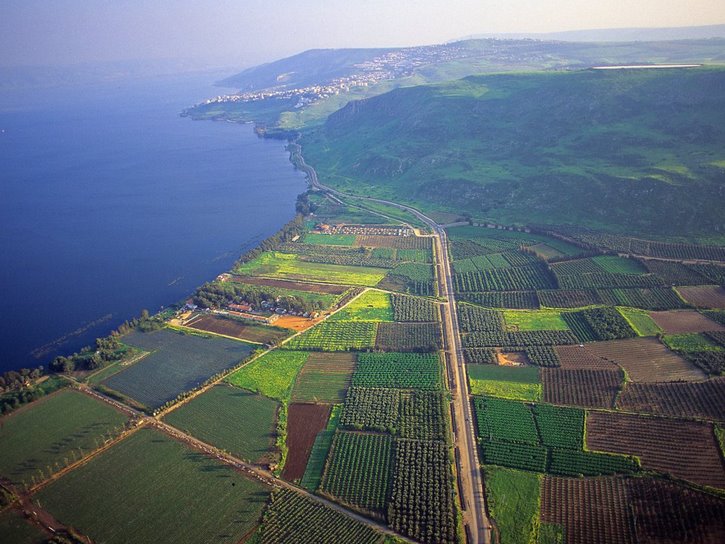
Sea of Galilee, Western Shore (photo by Jacob M. Van Zyl)
Tabgha, Byzantine Church (photo by Jacob M. Van Zyl)
Tabgha, mosaic of bread and fish (photo by Jacob M. Van Zyl)
The locality of this event does not affect its meaning and importance in the ministry of Jesus. However, for historical and geographical purposes it is always a plus if the location of an important event can be pinpointed. Tourists like to know they stand on the very spot where something great happened. The apostle John grew up in that region. He knew the name of every small place. He wrote his gospel about twenty years after Mark, Matthew, and Luke had completed theirs. John sometimes gives extra information to eliminate uncertainties. His remark in John 6:23 may hold the key to the Bethsaida controversy.
Tiberias, Sea of Galilee (photo by Jacob M. Van Zyl)
Sea of Galilee, western shore, looking south (photo by H. Isahar).
Sea of Galilee, north-west shore, looking north It was already evening (John 6:16, Mark 6:45-47) when Jesus sent the disciples by boat to the nearby Bethsaida Galilee, south-west of Tabgha (they later landed at Gennesaret, still farther south in the direction of Tiberias). If Jesus had fed the 5000 near Bethsaida Julias, the news about the miracle could not have reached Tiberias overnight.
The disciples wanted to return to Capernaum (John 6:16) but the strong wind against them (Mark 6:48) drove them to Gennesaret. When the wind died down they returned to Capernaum. Because Tabgha was close to Tiberias, people in Tiberias learned the next morning about the miracle and decided to investigate. John says, "they came in SMALL boats (ploiaria) from Tiberias near the place where they ate the bread" (literal translation).
A few other practical considerations argue against Bethsaida Julias as the site of the miracle.
The main reason for the controversy is probably the phrase "crossed over." It was not only used for West/East trips but also for North/South ones.
Have a good look at the map again, read the four gospels, keep the scenario explained above in mind, and the pieces of the puzzle will fall into place. For more pictures of Capernaum click here. ~~~~~
|